
DAMANI Group
Industrial Positioning & Identification Sensors
Track, understand and optimize every stage of the roll lifecycle using a data-driven industrial approach.
Continuous casting rolls operate within a complex lifecycle including manufacturing, storage, transport, assembly, production, inspection and maintenance.
In most steel plants, this lifecycle remains partially controlled, with limited traceability and weak connection between production and maintenance data.
The diagram below illustrates the complete lifecycle of continuous casting rolls, from initial identification to final disposal.
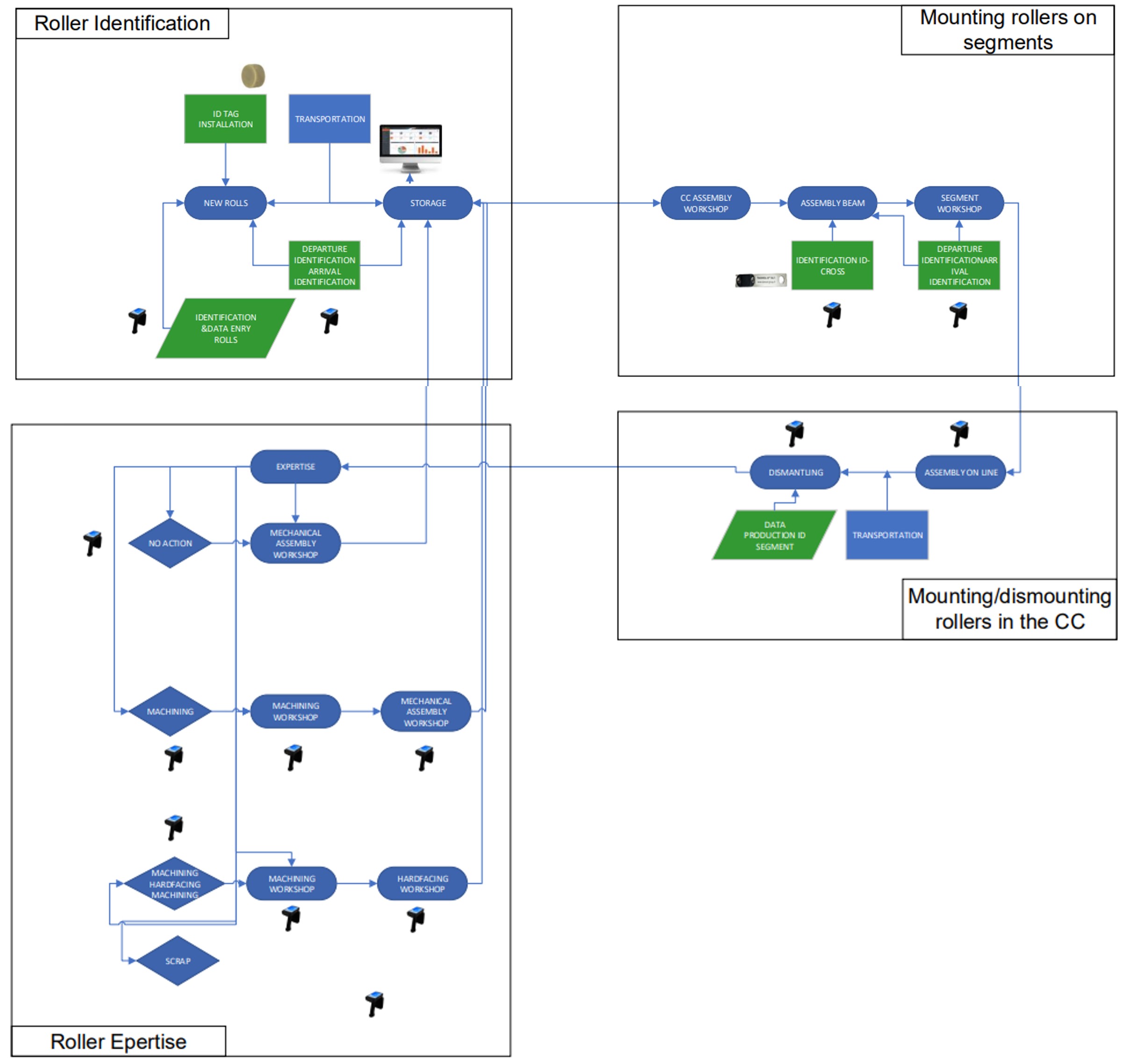
Each roll is identified at the beginning of its lifecycle using RFID technology. This enables full traceability and access to all technical and operational data.
Each roll becomes a unique industrial asset with its own digital identity.
During assembly, rolls are associated with crossbeams and segments. This ensures configuration consistency and improves operational performance.
Assembly decisions are no longer based on assumptions, but on reliable data.
After dismantling, rolls are inspected using their full operational history. Decisions such as machining, cladding or scrapping are data-driven.
Maintenance becomes more accurate, reducing unnecessary operations and improving reliability.
Production data is continuously linked to each roll, creating a direct connection between operating conditions and performance.
Continuous casting is no longer a black box, but a source of actionable data.
With TRACKROLL-ID®, every stage of the lifecycle becomes measurable, analyzable and optimizable.
Discover how TRACKROLL-ID® transforms roll management into a performance-driven system.
Discover TRACKROLL-ID®